Exercises That Make Childbirth Easier
It is possible to have an easy and fast birth with exercises that facilitate birth. Pregnancy exercise has many benefits and can even help prepare your body for childbirth. In this article, we will walk you through the exercises that facilitate childbirth. We’ll share why each exercise is beneficial for pregnancy and childbirth, and we’ll explain exactly how to do them. You can easily do all these exercises at home.
Exercising during pregnancy reduces back pain, constipation and bloating, allows you to sleep well and feel energetic, and is also good for mood swings. Since exercising while pregnant facilitates childbirth, it is absolutely necessary to do various exercises regularly according to the periods of pregnancy.
A study has shown that women who exercise regularly during pregnancy have a lower rate of giving birth by cesarean section, have less pain during childbirth, and have faster postpartum recovery processes.
Exercises that facilitate childbirth
While many types of exercise, such as swimming, walking, weight training, and aerobics, are beneficial during pregnancy, some exercises and stretching are especially helpful during childbirth. In this article, we share with you, our miracle mothers, how these simple exercises can benefit you and how to do them properly.
Gravity exercises
Among the exercises that facilitate childbirth, there are walking exercises and exercises with a pialtes ball, which do not tire you too much and are effective.
Walking
Walking during pregnancy is a great way to build up your resilience. Walking is a great cardiovascular exercise that doesn’t tire your joints. Walking towards the end of your pregnancy can help your baby come down due to gravity and the back-and-forth movement of your hips.
Pilates ball
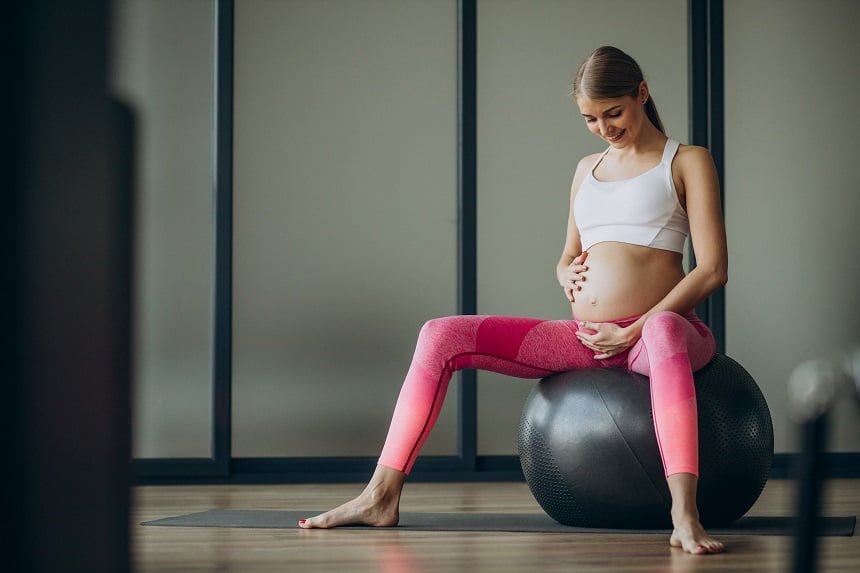
During pregnancy, pilates balls can be used for sitting, rocking, stretching, or as support. One of the best exercises to help with childbirth is the pilates ball exercises. It is known that women who participate in pilates ball exercises, especially in the classroom environment, have a reduced birth time. Here’s how you can use the pilates ball, the exercise that facilitates childbirth:
- Sit on a Pilates ball and swing your pelvis forward and backward, in circles to the side. This movement strengthens your abdomen and relieves pelvic and back pain.
- Sit on top of the Pilates ball and gently jump up and down. This movement can help your baby come down towards the end of labor.
Hip opening exercises
Squatting and leg opening exercises that will strengthen your uterine muscles can help you have an easy birth.
Squatting
Squatting is a time-tested and proven way to prepare for labor and give birth. Exercise strengthens your thighs and helps open up your pelvis.
- Stand with your feet slightly more hip-width apart and your toes pointing outward. If you need extra stability, hold on to a chair or other object for support.
- Contract your abdominal muscles, lift your chest and relax your shoulders. Then, lower your tailbone towards the floor, as if you were sitting on a chair. Find your balance – most of your weight should be towards your heels. Look forward to avoid slouching and straining your back. Wait like this for a minute.
- Take a deep breath and then exhale, then stand up.
Butterfly leg
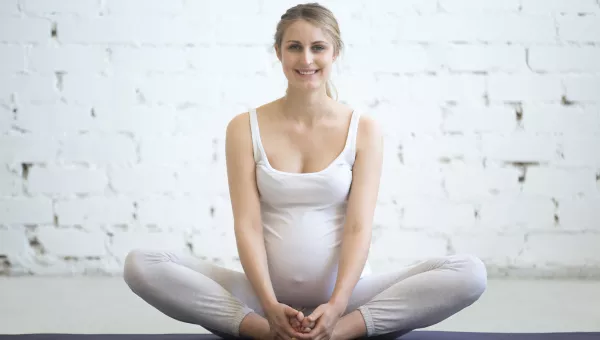
A butterfly lift is another movement that can open up your pelvis and will also stretch your inner thighs and back. Stretch this gently and be careful not to overstretch as your joints are looser during pregnancy.
- Sit on the floor with your hips touching the floor and sit with your knees bent outwards so that the bottoms of your feet touch each other in front of you. The closer your feet are to your body, the more intense the stretch will be.
- Keeping your back straight, lean forward enough to feel the tension in your inner thighs and back, and hold for a few seconds.
Back Exercises
You can do two different back exercises. Back stretching and bending. Now let’s look at the details:
Back Bend
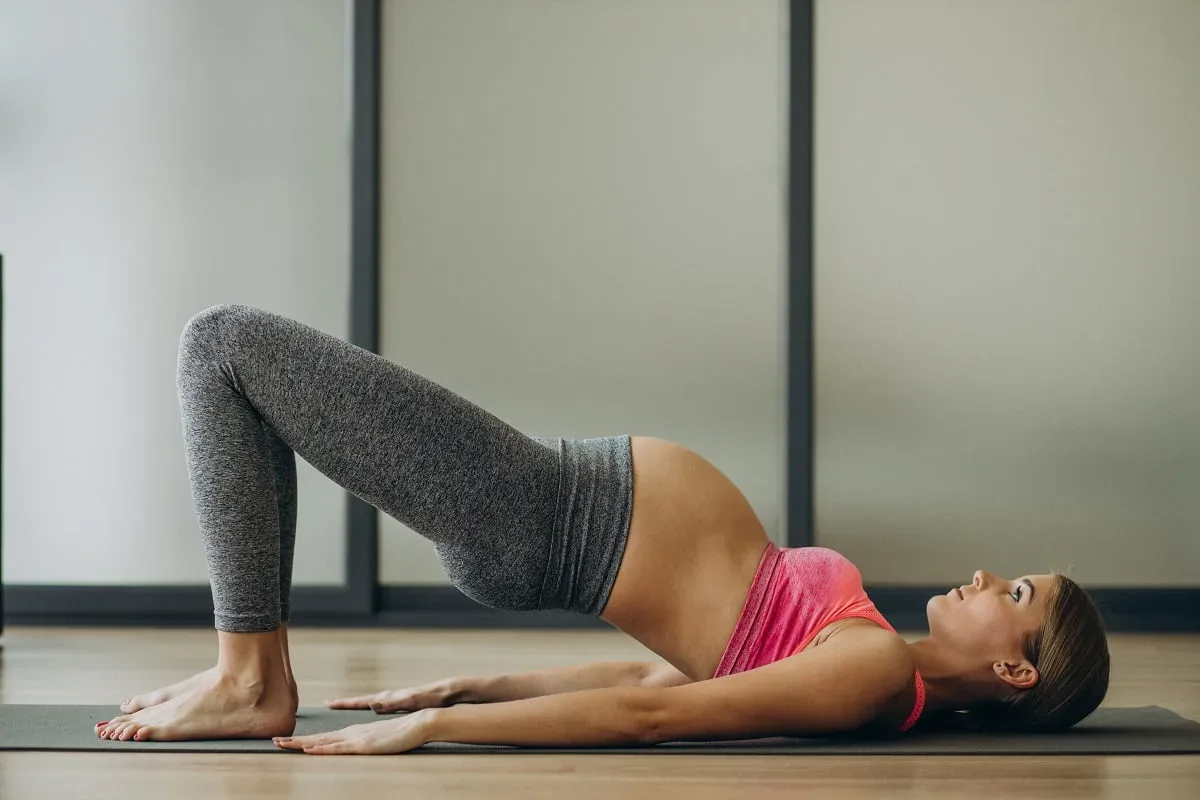
In the back bending (pelvic tilt) exercise, the hands and kneecaps are done in such a way that they touch the ground. This exercise strengthens the abdominal muscles and can relieve back pain during pregnancy and childbirth.
- Get down on your hands and knees with your arms shoulder-width apart and your knees hip-width apart. Keep your arms straight, but don’t lock your elbows.
- As you inhale, tighten your abdominal muscles, tuck your hips under you, and roll your back. Curl your spine around your abdomen.
- As you exhale, relax your back in a straight position.
- Repeat at your own pace, following the rhythm of your breathing: count to five as you slowly bend your back and push your pelvis underneath, and count to five as you slowly return to a straight position. Repeat this movement three to five times.
Back Lift
This exercise stretches the muscles along your spine and shoulders and the back of your legs. Try this exercise when you feel tension in your back. It can also help relieve muscle tension during childbirth.
- Facing a wall, lean forward from your hips so that your legs and upper body form a 90-degree angle. Your back should be straight, your legs straight or slightly bent.
- Put your hands on the wall at shoulder height. When looking at the floor, allow your head to relax and stay in line with your arms.
- Press your hands against the wall while leaning back from your hips until you feel a stretch in your back and back of your legs. Hold for five to 10 seconds, then relax and return your hips to their previous position. Repeat two to three times.
- A variation of this stretch can be done by standing in front of the birthing ball and holding the birthing ball instead of the wall. As you stretch, exhale and curl your spine around your abdomen.
Pelvic floor exercises
The Kegel Exercise works the pelvic floor muscles that support your pelvic organs, such as the vagina, urethra, cervix, uterus, bladder, small intestine, and rectum.
There is some evidence to suggest that strengthening the pelvic floor muscles can help with childbirth. According to the theory, if you can relax these muscles of your own volition, you can make it easier for your baby to be born. Pelvic floor exercises can also facilitate childbirth.
You can do the Kegel exercise anywhere. You can do it at work, at home, in the office, even while watching TV. Kegel exercise during pregnancy is performed as follows:
- First, start by finding your pelvic floor muscles: Can you squeeze the muscles around your vagina and interrupt your urine flow when you go to the bathroom? If so, you’ve found your pelvic floor muscles and just done a Kegel exercise. Practice a few times while urinating to activate this muscle group comfortably.
- Once you’ve learned how to strengthen and control your pelvic floor muscles, try doing long, slow contractions: Increase the contraction strength for five seconds, hold for another five seconds, then slowly relax for a count of five. Think of the pelvic floor as an elevator that goes up one floor for counting to five and goes down as you relax for a count of five. Perform long, slow contractions up to 10 or 15 twice a day.
- You can also do these movements quickly: Doing a quick kegel exercise strengthens a different type of muscle group in the pelvic floor. Contract the muscles quickly for two to three seconds by doing 10 to 20 repetitions. You can do up to 40 to 60 quick kegel exercises twice a day.
- Your abdomen, buttocks, and thighs should not move while doing these exercises, so consult an expert in exercising the right muscles.
Perineal massage
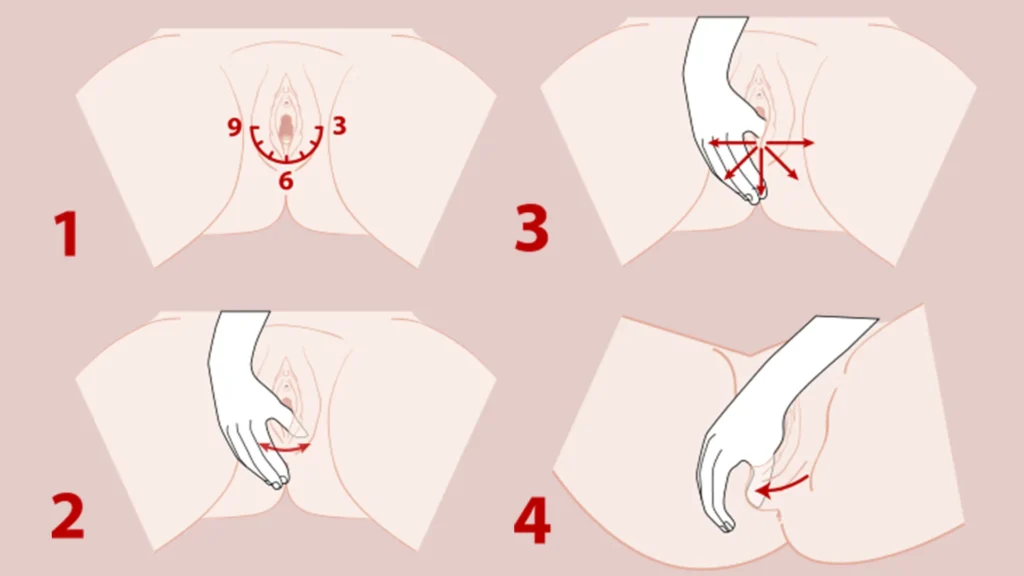
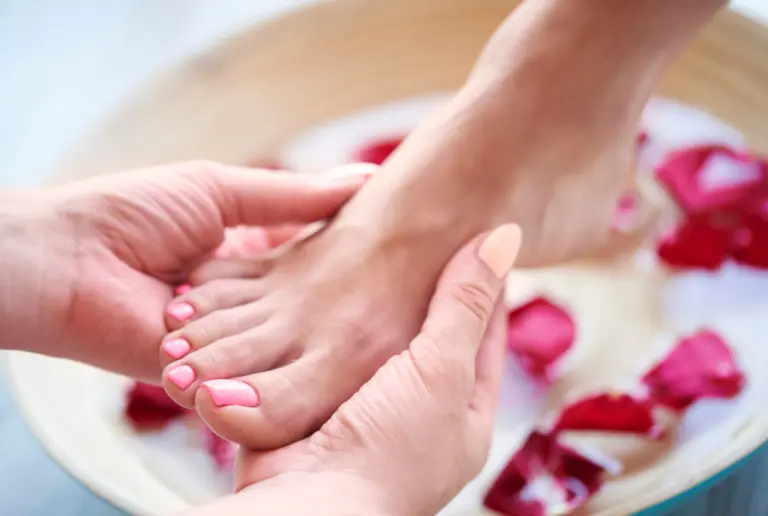
The perineum is the area between your vagina and anus. Perineal massage means gently massaging the tissue behind your vagina so that it stretches more easily during childbirth. This is something you can do yourself at home during the last weeks of your pregnancy to reduce trauma or rupture of the perineum during childbirth.
Deep Breathing exercises
Breathing deeply and focusing on your breath while relaxing prepares you to breathe this way during labor. You can practice deep and focused breathing as a relaxation method at any time. It’s also great to do breathing exercises in painful or stressful moments, or when you feel your body tense at any time of the day.
- Focus on your breath and close your eyes.
- Slowly take a deep breath in through your nose, then exhale through your mouth.
- As you exhale, release full-body tension. Try to completely relax your body.
- Each time you exhale, focus on relaxing a different part of your body.
Resources: