Painless delivery with Epidural Anesthesia
What is epidural anesthesia? Does an epidural hurt? Does an epidural cause back pain? Does epidural anesthesia harm the baby? Is it possible to give birth without pain with an epidural? In this article, we answer all the curious questions for our Miracle Mothers.
The thought of giving birth to your baby can keep you awake. It’s no secret that labor pains are painful and exhausting, but with the right medications, labor pain can be overcome. If you are going to give birth to your baby soon, you should be considering some options that can help you with labor pains. An epidural is an effective method of relieving labor pain and is a popular choice among pregnant women. However, it also has some risks, so it is necessary to have full knowledge of epidural anesthesia .

What is an epidural?
Epidural is a local anesthetic administered to relieve labor pain. Analgesics and anesthetic painkillers come in, which are injected through a tube in the back. An epidural blocks nerve signals from both motor and sensory nerves to reach your brain. It immobilizes your lower body while protecting you from pain and keeping you conscious during labor. An epidural can be used for both vaginal (normal) and cesarean delivery.
In childbirth, epidural anesthesia is administered through a hollow needle or a catheter to a small area outside the spinal cord (also called the epidural space) in your lower back. A catheter allows the anesthetic drug to be repeated or continuously administered as needed. Epidural injection for pregnancy is designed to provide partial pain relief for women, but the decision to opt for it is a personal one.
What are the Types of Epidurals?
Although hospitals and anesthesiologists differ in the dosage and combinations of medications, there are generally three types of epidurals used during labor.
- Conventional/Standard Epidurals
In addition to the regular use of a catheter, a traditional epidural uses regular anesthetic drugs such as bupivacaine or lidocaine, which greatly relieve pain. It is injected around the spine and numbs the lower part of the trunk. Pregnant women who receive epidural anesthesia have difficulty moving during labor. However, they can still move with a little help.
- Spinal Epidurals/Spinal Block
Unlike a traditional epidural, a spinal epidural involves injecting anesthesia directly into the spinal fluid. This provides quick relief from the pain of childbirth, but the effect of the drug wears off after a few hours. Spinal blocks are usually used in late labor. Once the spinal epidural is administered, it also restricts body movements.
- Walking Epidural or Combined Spinal Epidural (CSE)
These drugs are a combination of local anesthetic drugs and epinephrine. Unlike other epidurals, CSE allows you to feel a slight sensation in the lower part of your body. Therefore, mobility is not much of an issue in this case. The advantage of retaining some mobility despite the motor block potentially helps put the baby in a better position for faster delivery.

How is an Epidural Performed?
An epidural injection is usually given by an anaesthetist during the ‘active’ phase of labor. You will be asked to sit on the edge of the bed, bend your back a little, and just stand still. This position is important to prevent any complications and thus increase the effectiveness of your epidural medications. You can also lie on one side, bend and bend your knees as high as possible. Both of these positions provide a good curve of the spine to assess the exact place where the injection should be administered.
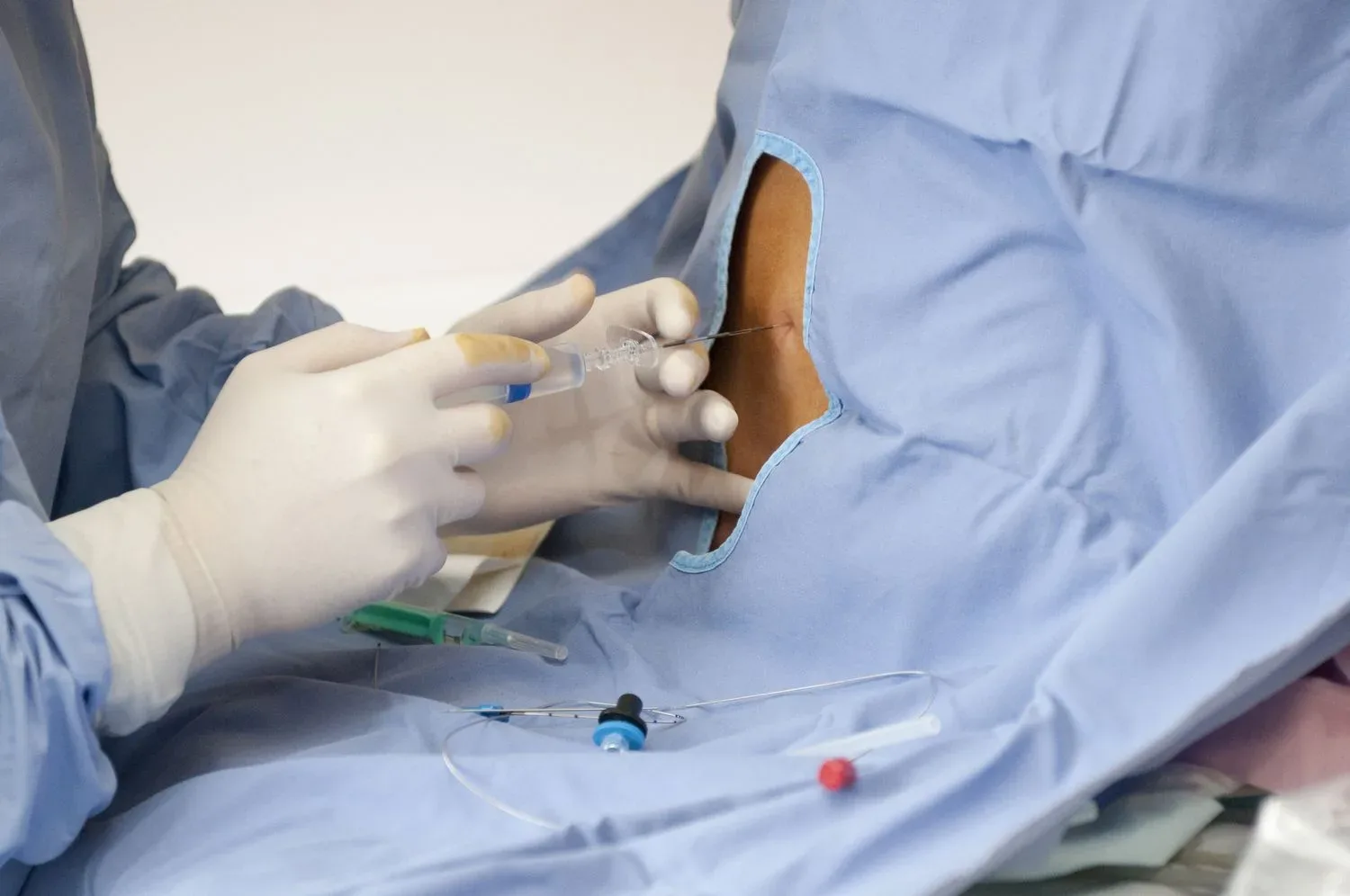
An antiseptic solution is applied to your skin to reduce the chance of any infection. A small area of your back is anesthetized with a local anesthetic, which is administered through an injection. A needle is then directed into the area surrounding the spinal cord in your back, and then a catheter is sent through the needle into the epidural space. The anesthesiologist then carefully removes the needle and leaves the catheter in place to administer medication as needed. The catheter is then securely taped to the back to maintain its position.
After completing the above procedure, there are several ways to administer an epidural that can be administered. All of these methods are very important to determine the amount of medication that should be administered for effective pain relief, depending on your threshold and condition:
1 . Epidural using a catheter : A catheter (a bendable thin and hollow tube) is carefully inserted into the epidural space created using a hollow needle. This allows for continuous or intermittent administration of the drug just outside the membrane that surrounds your spinal cord and spinal fluid. Your anesthesiologist will first give you a “test dose” to check the placement of the catheter tube and check for adverse drug reactions. If you do not develop any reactions, the test dose is followed by the full dose.
2. Intermittent Epidural : In this case, the medication is given according to the need. Depending on your level of tolerance to labor pain and the desired level of movement, your anesthesiologist will decide on the dose.
3. Mix and Match: The anesthesiologist mixes medications (anesthetics and analgesics) to suit your desired degree of sensation and movement.
4. Patient-Controlled Epidural Anesthesia: Thanks to this epidural, you can regulate the amount of medication injected into the epidural tube.
5. New Epidural Births : Also called a ‘walking epidural’, this particular analgesia gives the mother the freedom to stand, kneel, squat and even walk with a little help.
6. Spinal Epidural Analgesia : The newest pain reliever is known as spinal analgesia or ‘walking spinal’. Only a small dose of the drug is injected into the spinal fluid to reduce labor pain, but it still allows movement.
7. Low-Dose Epidural : This is a type of combination (narco-anesthetic) epidural. The tired mother is able to recover from the labor pains enough to gather some energy to relax and strain.
How does epidural anesthesia work?
An epidural temporarily blocks the nerves in your cervix and uterus, which carry pain signals to your brain, thereby reducing sensation.
Epidural medications include drugs called local anesthetics, such as bupivacaine, chloroprocaine, or lidocaine. They are often given in combination with opioids or narcotics so that local anesthetics can be used less frequently.
This provides relief from the pain of childbirth and has limited side effects. Such drugs can also be used to prolong the effect of the epidural or to stabilize the mother’s blood pressure.

When is an epidural done?
There is no right or wrong time to have an epidural analgesia during labor. However, it is usually given during the active phase of labor, when a woman feels frequent contractions and the cervix dilates.
An epidural may also be recommended to speed up labor. This is done with a hormone called synthosinone, which is administered in the form of a drop, which makes the contractions more intense and painful.
The epidural should remain in place until your baby is born. If you need episiotomy stitches, it can also reduce pain after delivery.
Advantages of Having an Epidural
Epidurals are an excellent choice for relieving labor pain better than other medications. Women who undergo epidural anesthesia feel little or no pain during labor. Other benefits include:
- It does not significantly increase the duration of childbirth.
- You may be able to stay awake, but you will still feel the pressure and some yawning during labor.
- Combined spinal-epidural (CSE) gives better results compared to standard epidural. It contains lower doses of anesthetic drugs that give you more muscle strength.
- If necessary, its strength can be increased with local anesthesia. Also, having an epidural does not increase your chances of needing a cesarean section.

What are the side effects of epidural?
An epidural can be used to administer different types of local anesthetics. And each type has its own side effects. Here are some of the common side effects of an epidural.
- Itch: Itching is a common side effect of an epidural. If you experience itching, changing the medication may help resolve the issue.
- Blood pressure problems and fever: Even a small dose of epidural It can cause a drop in blood pressure or fever. However, this is normal.
- Numbness or tingling sensation in the legs: This condition can cause difficulties when urinating. A urinary catheter is normally used to help you urinate in such cases.
- Risk of spinal fluid leakage: If the injection goes too deep, it can open a hole in the protective layers around the spinal cord (dura) and the spinal fluid can leak out. This can cause headaches that can last for days. This may be due to fluid loss.
- Longer delivery time: In women who have an epidural, childbirth may take a little longer on average.
- Assisted birth: Some women may feel the urge to push even though they have an epidural. They may not feel that it is time to push due to the epidural, they may need assisted delivery (vacuum suction/forceps).
Does an epidural harm the baby?
In general, epidurals are safe for the baby because they are injected into the spine and not intravenously. Any medication given to a woman during childbirth necessarily reaches the baby’s bloodstream through the umbilical cord. This includes pain-relieving anesthetics given through an epidural. However, anesthetics use drugs that are as safe as other painkillers given to expectant mothers and therefore do not affect the baby too much. There are no long-term side effects of using epidural anesthesia.
However, because the baby’s immune system is not fully developed, it takes longer to cope with the effects of epidural medications. The drop in the mother’s blood pressure due to the epidural can cause discomfort to the baby, as it can affect the oxygen supply.
Is epidural delivery painless?
Epidural block reduces labor pain. Having said that, it doesn’t completely relieve the pain.
On average, it takes about 40 minutes for the epidural to take effect after being injected. The process of applying it is painful and can be quite uncomfortable. If the same drug is used in a lower concentration, it causes analgesia, that is, it only relieves pain without causing any muscle weakness. However, if the epidural doesn’t work, your doctor may need to administer the epidural again.
Getting an epidural reduces some pain, but a ‘pain-free birth’ is not entirely possible.
Does the Use of Epidural Injections Cause Back Pain?
Even after giving birth with the help of an epidural, some women may experience mild pain in the area of the catheter where the drug was injected. Using epidural painkillers during labor does not cause long-term back pain. While many women believe that epidural analgesia causes severe or prolonged back pain, they are unrelated. Postpartum back pain is caused by pre-existing prenatal back pain or is a result of normal physiological changes during pregnancy.
Epidural and Multiple (Twin) Pregnancy
It is not necessary for twins to have a cesarean delivery. Just like a single birth, many twins are born vaginally. Epidurals are often recommended by doctors for pain relief during childbirth, as well as when preparing to bring the second child into the birth position.
If there are any problems, it is practically easier for your prenatal team to deliver your babies quickly if you have already had an epidural.
What happens after childbirth?
During pregnancy, it’s important to focus on the birth of your baby. But it’s also a good idea to know what happens after the birth. Here’s what to expect after the birth of your child.
- The umbilical cord will be clamped and cut, and dried and covered so your baby doesn’t catch a cold.
- The mucus will be cleared from your baby’s face. Some babies need help getting their breathing back to normal.
- Your doctor may recommend that you stay close to your baby to ensure skin-to-skin contact.
- Your baby will be examined, weighed and measured by a pediatrician, and given a band with your name on it.
Childbirth is not easy, but the decision to choose an epidural or other method of labor pain relief should be entirely yours. If you want to opt for any method of labor pain relief, do your research, talk to your doctor, and have a safe labor and delivery.