What is the Triple Screening Test? When is the 3-Way Test Done?
Triple scan test It is one of the tests performed during pregnancy. It is recommended to be done at 16-18 weeks of pregnancy. With this test, the baby’s risks for hereditary diseases such as Down Syndrome, Neural Tube Defect (NTD) and Anencephaly are evaluated.
Pregnancy Tests are one of the most basic requirements of the pregnancy period. Especially during pregnancy, some tests should be performed in order to have information about the general health status of the baby at every period.
From the moment it is learned that there is a baby in the mother’s womb until the birth occurs, some tests are performed in the process. Thanks to the tests performed during pregnancy , the development of the baby can be followed more closely.
In this article, we have put together what you need to know about the 3-way screening test .
What is the Triple Screening Test? How?
The triple test, also known as the triple screening test, is a test that should be done between the 16th and 18th week of pregnancy. During the triple screening test, a blood sample is taken from the expectant mother.
3 different hormone measurements can be made with the blood sample taken. Similarly, as in the double screening test, the risk status of pregnancy can be determined in the triple screening test. Especially if pregnancy is risky, a quadruple test can also be performed.
Which Health Problems Are Determined by the 3-Way Test?
Thanks to the triple screening test , which is recommended to be performed after the 15th week of pregnancy, chromosomal disorders that may occur in the baby can be detected.
Down syndrome and edwards syndrome can be determined by the triple test. While a neural tube defect cannot be detected during the double test, this abnormality can also be detected with the triple screening test.
Who Can Have the Triple Screening Test?
The triple screening test, which is recommended for almost every expectant mother during pregnancy, is especially recommended for the occurrence of some conditions. These situations can be listed as follows:
- If there is a congenital defect in the family history of the mother or father-to-be,
- When the age of the expectant mother is 35 and over,
- In case of taking pills or drugs that will be harmful during pregnancy,
- Expectant mothers who use insulin and those with diabetes,
- In expectant mothers who have had any infection caused by viruses during pregnancy,
- In the case of children born with abnormal conditions in previous births, the triple screening test should be performed in particular.
How accurate is the triple screening test?
The accuracy rate of the triple screening test, which is recommended to be performed especially for the detection of babies with Down syndrome, is approximately 70%. For this reason, only the triple screening test in pregnancies may not be sufficient to determine abnormalities.

What are the hormones that are examined in the triple screening test?
In order to perform the triple screening test, the blood sample taken from the expectant mother is examined. The 3 different hormones examined during the triple screening test are:
AFP Hormone
The AFP hormone, which is defined as the protein produced by the baby’s liver, continues to increase in the mother’s blood values with the progression of pregnancy.
Beta – hCG Hormone
The hormone beta – hCG is produced in the placenta. The beta-hCG hormone in the mother’s womb in the early stages of pregnancy begins to increase gradually every week with the progression of the process.
E3 hormone
The E3 hormone is a type of hormone that is found and produced in the placenta and the baby.
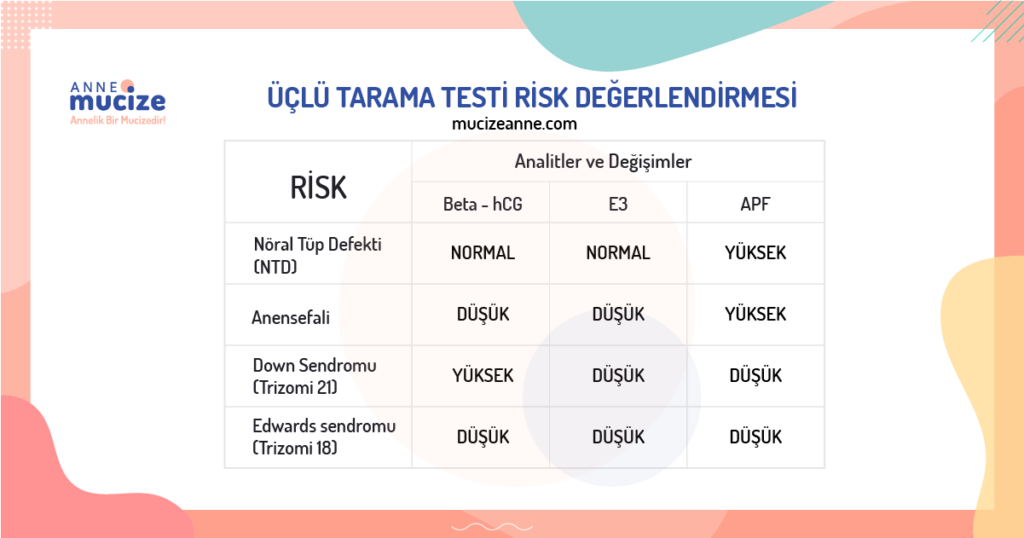
Neural Tube Defect (NTD) Prediction with 3-Test
The level of APF hormone in the blood of a pregnant woman is between 10-150 ng/mL . If the APF hormone level is above normal levels, the baby’s risk of having an NTD is considered high. The level of APF hormone in the blood of mothers of babies with NTDs can be twice as high as normal.
In order for the results of the triple screening test to be healthy, the week of the test must be determined correctly. If the gestational week is higher than predicted, then the APF value will be high and the baby’s risk of NTD will be incorrectly estimated.
Down Syndrome Prediction in the 3-way test
If APF and E3 hormone levels are lower than they should be and beta-hCG hormone is above normal levels according to the week of pregnancy, the baby is considered at risk for Down syndrome.
- The cut-off value for beta-hCG for Down syndrome is 1:250.
- The cut-off value for beta-hCG for Edwards syndrome (Trisomy) is 1:100.
What should be done if the triple screening test is positive?
If the result of the triple screening test is positive , it can also make inferences about the risk rate of pregnancy. If the risk ratio is above 1:250 at the end of the test, it can only be understood that there is a risk situation above normal.
As a result of this value, it cannot be said that the baby will definitely be born with Down syndrome. Amniocentesis and other advanced examinations should also be performed in order to make a complete diagnosis.