
Screening and tests during pregnancy
Screening and tests performed during pregnancy are essential for a healthy pregnancy process. With pregnancy, a series of changes occur in the body system. In order for the pregnancy process to continue in a healthy way and for a healthy baby to be born at the end, some scans and tests are performed specifically for the weeks of pregnancy and if necessary.
With the finalization of the pregnancy, regular doctor check-ups are made. The main purpose of these controls is to ensure the health of the mother and baby. A series of scans and tests are performed under the doctor’s controls. Thus, the risks that may be encountered in advance are evaluated. Risky pregnancies can be terminated, and healthy pregnancies are successful.
Screening and Tests During Pregnancy
Tests for the Detection of Pregnancy
The first test performed during pregnancy is the test for the detection of pregnancy. This test is done by taking a urine sample. If deemed necessary, a blood test can also be applied. In both tests, beta-hCG value is checked. The value of Beta HCG as a pregnancy hormone is between 0-10 mlU/ml in a non-pregnant woman. If the Beta HCG level in the blood is above 10 mlU/ml, it means that there is a possibility of pregnancy.
Tests Performed Under the Control of the First Doctor
After the pregnancy is confirmed, the following values are checked in the blood test performed under the control of the first doctor.
- Infection screening,
- Hemogram,
- Complete urine test,
- TSH test (Triode gland test),
- Toxoplasma IgM and IgG,
- Rubella IgM – IgG,
- HBSAg for hepatitis B,
- HCV,
- HIV
- VDRL test for syphilis (syphilis),
- HbA1C test,
- Biochemistry tests (cholesterol, kidney, liver, etc.)
Blood Incompatibility Test (Indirect Coombs)
A blood incompatibility test is a test performed in the first weeks of pregnancy. If the mother-to-be is Rh- and the father-to-be is Rh+, a blood incompatibility test is performed. With this test, the blood interaction between the mother and the baby is examined.
11 -14. Weeks
Double Screening Test (2-way screening test) is performed at 11-14 weeks of pregnancy. With this test, the baby is examined in terms of hereditary diseases and the risk group is determined. It is also known as the Down Syndrome test.
See also: What is the Dual Screening Test?
16 -20. Weeks
The Triple Screening Test (3-way screening test) is a blood test performed at 16-18 weeks of pregnancy. Three different hormone levels are checked in the blood taken from the expectant mother. With this test, chromosomal diseases such as Down’s syndrome, Edwards’ syndrome and also Neural Tube Defects anomalies of the baby are examined. With the widespread use of the quadruple test, the more comprehensive 4-way test is generally preferred instead of this test.
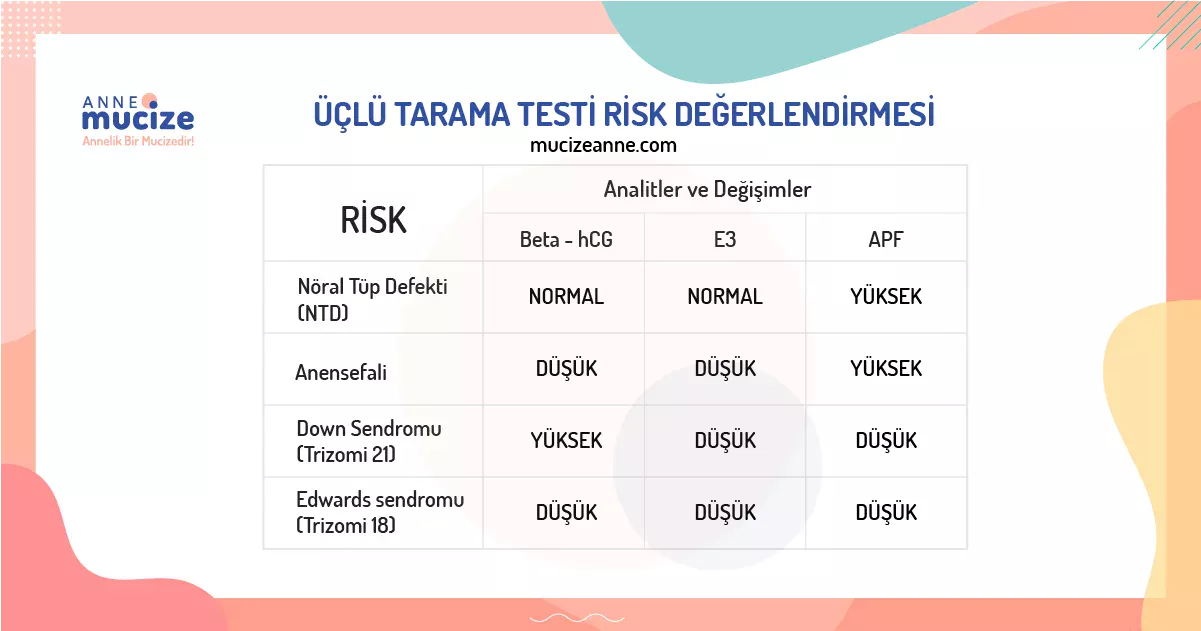
See also: What is the Triple Screening Test? When is it done?
The Quadruple Screening Test (4-way screening test) is a blood test performed at 16-18 weeks of pregnancy. In the quadruple screening test, the baby’s chromosomal diseases such as Down syndrome, Edwards syndrome, as well as Neural Tube Defects anomalies are examined.
See also: What is a quadruple test? When is it done?
With the Blood Count (Hemogram), triot and other blood values are checked.
With amniocentesis (performed if necessary), some samples are taken from the amniotic fluid in the baby sac by surgical methods. It is an advanced test for the detection of genetic disorders such as Down syndrome.
18 -23. Weeks
Detailed Ultrasound Scan and Detailed ultrasound scan is a scan in which all organs of the baby are examined with high image quality, unlike ultrasounds performed in normal controls. Detailed ultrasound is performed at 22 – 24 weeks of pregnancy. Detailed ultrasound and Detailed Ultrasound are different procedures.
Detailed ultrasound is often confused with three-dimensional ultrasound or color ultrasound. These are different imaging and techniques. A 4D image (4D) of the baby is taken with detailed ultrasound. In this way, the development of all its organs is examined. If there is a retardation in the growth and development of the baby, it can be detected.
Detailed ultrasound , on the other hand, is performed by radiologists or perinatologists between 19 and 23 of pregnancy. It is done in weeks. It is an imaging technique that is usually performed through the abdomen. If necessary, it can also be done vaginally to determine the width of the cervix.
Fetal Echo is a test performed if deemed necessary at the 21st week of pregnancy. If there is an individual or individuals with chronic heart disease in the family, if there is a history of miscarriage due to heart diseases in previous pregnancies, the doctor may request this test. This test can be done between 16-24 weeks. This procedure is performed with a special ultrasound imaging technique.
24 -28. Weeks
The Sugar Loading Test is a test performed at 24-28 weeks of pregnancy. This test is performed to detect high blood sugar that occurs with pregnancy. Thanks to the sugar loading test, the expectant mother can be loaded with sugar from the outside and a conclusion can be reached according to the reaction of the body. It is recommended to perform a sugar loading test for expectant mothers between the 24th and 28th weeks of pregnancy.
Also read: Sugar Loading Test During Pregnancy
The Doopler Screening Test can be performed from the 20th week of pregnancy. With this test, the blood flow of the main arteries of the uterus is measured with a Doppler device. With the Doopler test, abnormal conditions such as uterine growth retardation, premature separation of the placenta, and death of the baby in the womb can be detected.
After Week 28
With the NTS test, the baby’s heartbeat and the mother’s uterine contractions are monitored. It is a widely used prenatal test to check the baby’s health. This test records the baby’s heartbeat, uterine contractions. The NTS gives information about whether the baby is getting enough oxygen. The NTS test is a weekly test between 35 and 40 weeks until birth. If the baby is at risk of premature birth, this test may be requested in earlier weeks.
Roof Examination includes examining the birth tract, which consists of bones and muscles, before birth. In this examination, the presence of any negative situation that will prevent the baby from being born in a healthy way is examined. Since the vast majority of pregnancies result in the 38th week, they are usually performed at the 37th week.